
Considering adopting a Cavalier King Charles Spaniel, yet you are confused whether to get a boy or a girl? You’re not alone! The question many aspiring pet parents often have is, What kind of pet should they get (male or female)? Cavalier King Charles Spaniels make great pets, but which one is better: the male or the female? The answer to this is that both are equally good pets.
Although the dogs are all different, certain behavioral, physical, and health variations exist between the sexes that can be used to select the best one to suit your lifestyle. Personality quirks, grooming comfort, and training preferences, getting to know what these differences can do will make sure you make a choice that will not only serve you but that will also serve your future furry companion.
Here we shall investigate in this guide the greatest differences of temperament between the male and female Cavaliers, what science and experience teach us about the temperaments of these two, and how to obtain the most suitable companion at home.
Table of Contents
What Is This Comparison About?
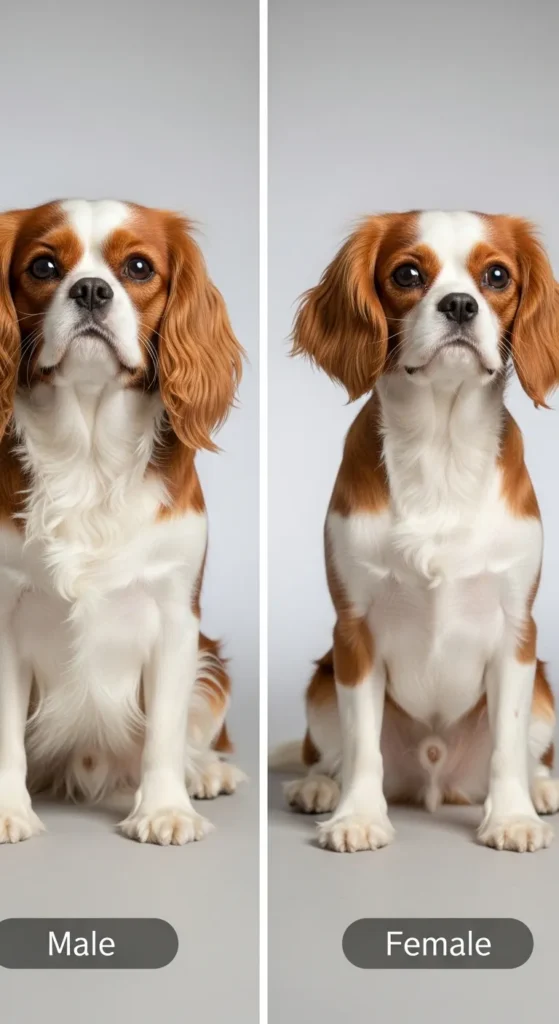
The male vs female Cavalier King Charles Spaniel contrasts allow dog owners to be aware of the biological sex and how it determines the temperament, size, and long-term care.
The breed standard remains the same: affectionate, gentle, and adaptable, despite slight variations in behavior and development between male and female Cavaliers, which are attributed to hormonal and genetic differences.
Nevertheless, these tendencies are not absolute. The personality of a dog is typically shaped by its environment, early training, and socialization, rather than solely by its gender.
Why It Matters When You Select Your Cavalier.
The decision between male and female Cavaliers has the potential to affect:
- Home levels of energy and playfulness.
- Training and bonding styles are easy.
- Coexistence with old pets.
- Such health factors as spaying/neutering or gendered risk.
- Hygiene and care requirements.
These nuances enable an understanding of which type of dog suits a family best, particularly when it is the first pet or when a new dog is introduced into a multi-pet household.
Root causes / Background Information: Why are males and females different?
Numerous behavioral variations of the male and the female Cavaliers are based on hormonal effects and evolutionary behavioral tendencies typical of dogs:
Testosterone affects the male Cavalier, particularly those that have not been neutered, which may make them more playful, pleasing, and even more attention-seeking.
Estrogen periods have the potential to cause temporary mood swings or even temporary independence in female Cavaliers because of the heat period affecting their behavior.
After they are spayed or neutered, these hormonal variations tend to become less apparent; however, they often leave behind some faint patterns of personality.
How to find the Differences: Male vs Female Characteristics.
The following are the most distinguishable characteristics of male and female Cavalier King Charles Spaniels to their owners and breeders:

1. Temperament
- Males: In most cases, they are more affectionate and physical attention seekers. They are more likely to be velcro dogs and be with their owners wherever they go.
- Women: They are generally autonomous, relaxed, and respectable. They will be affectionate on their terms but establish powerful, loyal relationships.
2. Trainability
- Males are generally more active and can be easily distracted, particularly during their youth. Their reaction to positive reinforcement is good.
- Females: They mature quickly, and they usually pay more attention during training. The owners have found some of them (females) easier to house-train.
3. Size and Build
- Males are generally slightly larger, weighing approximately 13 to 18 pounds, with fuller bodies and larger chests.
- Women tend to be 12-16 pounds and smaller in size and appearance.
4. Love and Interpersonal Relationships.
- Males: Sociable, affectionate, and not shy of strangers.
- Women: docile and motherly, although they do not open up easily to strangers or other dogs.
5. Health and Lifespan
There are breed-specific risks found in both sexes, which include: mitral valve disease, patellar luxation, ear infections, but:
- Women are at risk of developing mammary tumors or uterine infections if they do not get spayed.
- Males may develop prostate issues or marking behaviors if not neutered.
Remedies / Advice on Caring for Both Sexes.
1. Have Spay or Neuter Properly.
The majority of vets recommend spaying or neutering your Cavalier when they are 6-9 months old, as per your health and development. This is useful in reducing hormonal behaviors and preventing some cancers.
2. Healthy Eating and Exercise.
Irrespective of gender, cavaliers are likely to become obese. Select a high-quality small-breed formula and feed it to your dog in moderation to help them achieve a normal weight.
3. Consistent Grooming
Both genders possess long, silky hair that should be brushed several times a week. Denser feathers may require additional trimming of males.
4. Socialization and Mental Stimulation.
Take your Cavalier abroad at a tender age. Males may require assistance in learning to be relaxed and exhibit good manners, while females may need play to instill confidence and help them overcome shyness.
VET INSIGHTS / EXPERT NOTES
Due to the agreement of veterinarians and breeders, it is possible that sex can affect tendencies, but the most significant role in the temperament of a Cavalier was played by training, socialization, and care.
According to Dr. Lisa Freeman, a veterinary nutritionist at Tufts University, the female gender does not have a significant influence on a dog’s long-term behavior and well-being compared to environmental factors and health management.
That is, do not pick the dog whose gender fits your family, but whose personality.
COMMON MISTAKES TO AVOID
- Making decisions based on stereotypes only (e.g., males are friendlier).
- Postponement of spaying/neutering, non-medical.
- Disregarding early socialization and training in obedience.
- Overeating– both genders will put on pounds with ease.
- Making assumptions about the reduced efforts or attention needed in females.
FAQ’s
Are male cavaliers more affectionate?
As a rule, yes, male Cavaliers are clingier and more affectionate, but all dogs are different.
Do male Cavaliers like female Cavaliers better?
Females tend to get along with males but may become territorial with other females, particularly the unspayed ones.
Who is the greater shedding male or female?
Both shed similarly. But that does not mean that males with thicker coats require more brushing.
Are males or females the ones who live longer?
They are also similar in their average lifespan (12-15 years), although spayed women possibly have a little less risk of some diseases.
Which is easier to train?
Women can reach maturity sooner and are more attentive, yet men can be well-trained as women with patience and reward.
CLOSING THOUGHTS
Being a male or a female, any Cavalier King Charles Spaniel will bring unlimited happiness, faithfulness, and love. The gender variations are fine-tuning of the sexes; what makes a dog who he is is everything that you give him in terms of love, care, and consistency. Instead of the question of which is better, it would be best to ask which one suits your home and your heart. In any case, you are getting a lifelong friend.