
Nothing is as relaxing as having a lovely Cavalier King Charles Spaniel around, with their round eyes, smooth hair, and nature that is so endearing to all. But even the most loving Cavaliers must delight their masters with sudden yellings. On the one hand, you are not the only person who has turned your quiet pup into a chatterbox. The question that many pet parents would have is, Do cavaliers bark a lot? or “Why is it my Cavalier will not shut up as I get out of the room?
Table of Contents
It is not only about peace that you will need to understand why your Cavalier King Charles Spaniel barks and the ways to deal with anxious barking, but you are likely to make your dog feel safe, secure, and emotionally healthy.
What Is Cavalier Barking?

Cavalier barking is a term that characterizes sounds that are conveyed by this docile breed to express needs, emotions, or alerts. Although Cavaliers are not renowned for being overbarkers as compared to other breeds, such as Terriers or Beagles, they are sensitive dogs. Their barks are usually that of excitement, anxiety, or stress of separation as opposed to aggression and territoriality.
In simple terms, your dog also speaks, or barks, and in the case of the Cavaliers, that conversation usually revolves around you paying them some attention or letting them know how lonely they feel.
Why It Matters For Dogs
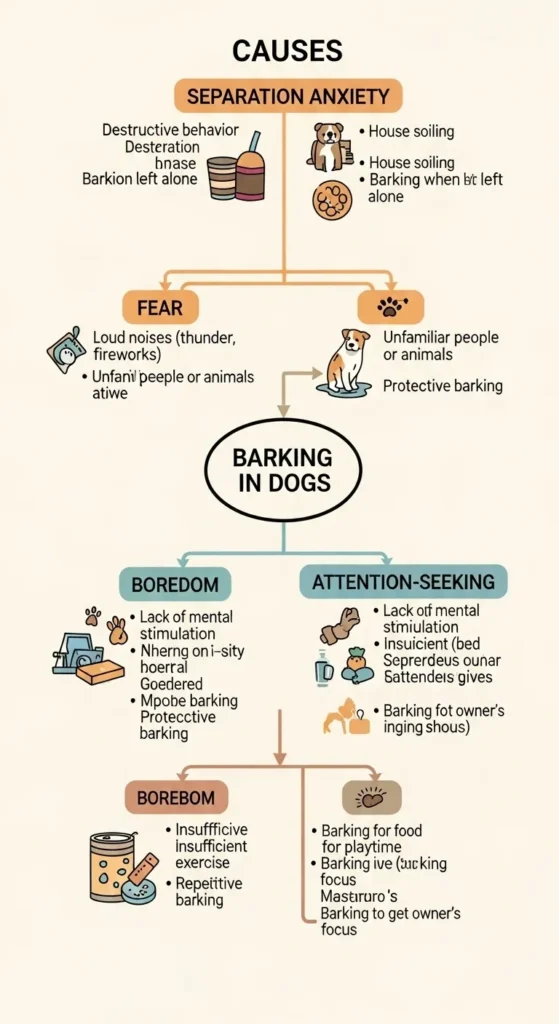
Controlling the barking does not mean quieting down your Cavalier; it means learning to interpret the meaning of its bark. Constant or nervous barking may be a sign of distress or illness.
Unaddressed, it may lead to:
- Heightened anxiety (particularly, separation anxiety).
- Poor relationships with neighbors or other pets.
- The inability to relax may influence sleep and good health.
Early intervention of the problem of barking helps you take care of the mental health of your Cavalier and close the affectionate relationship that is the hallmark of this breed.
Causes / Background Info
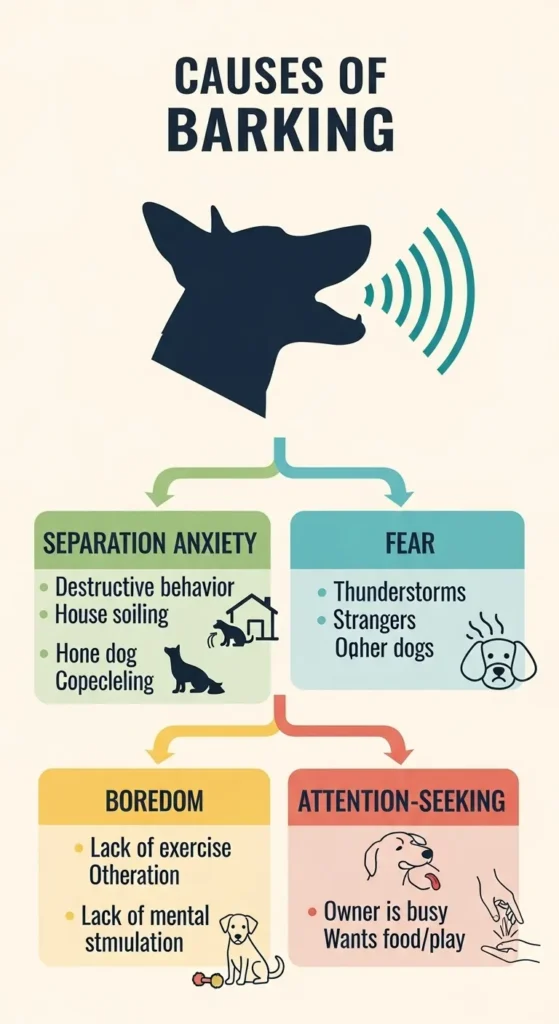
Cavaliers are companion dogs; they need to be around people and love them. They can develop anxiety, which is manifested by their act of barking, whining, or pacing when separated or not given the required attention over an extended period of time. The usual causes of the Cavalier barking include;
- Separation Anxiety: One of the most likely to have separation anxiety is the Cavalier. They establish strong bonds with their owners and would be upset when they are alone.
- Attention-Seeking: When your Cavalier gets to know that barking will attract attention, even though it might be chastisement, they are likely to repeat the activity.
- Boredom or Lack of Exercise: A hyperactive Cavalier will bark as a way of venting his spleen or to play.
- Environmental Triggers: Barking can be easily aroused by bell-ringing, weird sounds, or even a passing dog; more so when your Cavalier is on guard.
- Fear or Stress: Fearful barking can be brought about by loud sounds (such as thunderstorms) or by a change in routine.
- Medical Causes: In other cases, the reason behind barking may be pain, deafness, or the Cavalier’s loss of function in older dogs. Never exclude medical causes with your vet.
Indicators & Symptoms of Anxious Barking

But how shall ye know whether the barking of thy Cavalier is of anxiety or jesture? Look for these signs:
- Immediately after leaving the house, the dog barked.
- Crying, fussing, or causing havoc in the manner of not being around.
- Panting or overdrooling.
- Shaking or concealing on being startled.
- Barking, which gets higher with stress (not excitement)
- By identifying these signs, you deal with the problem, not the sound.
Solutions / Care tips / Prevention.
- Create Self-Reliance in Bitches.
- Get your Cavalier to like to be separated, beginning with brief ones.
- Go away a little, and then come back composedly.
- Progressively widen the intervals of separation.
- Do not have some dramatic exits or greetings; this will teach one to behave calmly.
- Provide a Comfort Zone.
- Take something of your garments and leave it with your smell.
- Play background music that is soft or music that is dog-friendly.
- Give a comfortable bed in a soothing and secure location.
- Physical stimulation and mental stimulation.
- A weary Cavalier is a tacit Cavalier.
- Daily walks (30-60 minutes total)
- Snuffle mats or puzzle feeders.
- Fetch or catch games, which are gentle in nature.
- This assists in the release of energy and elimination of boredom-causing barking.
- Positive reinforcer training.
- Use rewards to teach one of these commands: quiet.
- Wait for a pause in barking.
- Ask to be quiet and give a reward (treat or praise).
- Repeat consistently.
- Do not yell, and this may complicate the barking process.
- Overcoming Separation Anxiety through Slow Conditioning.
- In case your dog becomes hysterical when you are away, employ desensitization:
- Take up your keys or take off your shoes, and sit down.
- Go on until your Cavalier has no more connection with these signs and leave.
- Gradual absences gradually compound over time.
Consult a Professional
In case of extreme anxiety, a veterinary behaviorist should be asked. They are able to prescribe training programs, nutritional supplements, or medication where needed.
Vet Insights

Veterinarians and trained animal behaviorists underline that it is not a bad behavior, but rather a symptomatic one that is caused by barking. Dr. Karen Overall, who is a veterinary behavior specialist, observes that the first step to solving a dog’s barking is to understand the cause of the behavior.
- Securing adequate physical activities and socialization.
- It is important to avoid punishment-based tools (such as shock collars).
- To the planned comforts of the routine.
- Take into account pheromone diffusers (such as Adaptil) that are calming.
Common Mistakes To Avoid
- Shouting or screaming at your dog because he or she is barking.
- And leaving your Cavalier behind you.
- Disregard the symptoms of anxiety or stress.
- The punishments are collars or sprays.
- Rewarding silence instead of dealing with its cause.

FAQ’s
Are Cavalier King Charles Spanters silent animals?
Generally, yes. Cavaliers are moderate barkers, although some will bark more when anxious, excited, and lonely. Training at an early age can control this.
Are Cavaliers easily prone to separation anxiety?
Yes, Cavaliers are highly social and cannot work alone for a long time. Gradual training on independence can be used.
Will I put my Cavalier in the cradle?
Some dogs can be comfortable being crated, but they must be linked with safety, not punishment. Begin with positive reinforcement and short sessions.
Which of her cries hushes the yelling Cavalier?
Anxiety-induced dog-barking in sensitive breeds can be alleviated through soft classical music or through the use of soundtracks in the form of Through a Dog’s Ear.
At what times should I visit a vet for barking?
In case the barking of your Calvie is suddenly more frequent, is accompanied by signs of distress, or is disruptive to everyday life, then see your doctor or a behaviorist.
CLOSING THOUGHTS
The fact that you bark is not bad; it is communication. Your Cavalier King Charles Spaniel is barking at you, so it must be necessary to listen to his message. Knowing their feelings, fulfilling their needs, and treating your furry companion with tolerance and affection, you will make your pet feel safe, at ease, and calm, and put your home in balance again.